

If you’re new to pickleball, there’s a good chance you’ve asked at least once:
“Wait… what’s the score again?”
You’re not alone. Pickleball is one of the easiest sports to learn, but the scoring system can feel confusing at first — especially in doubles where you hear three numbers like “7–4–2”.
The good news? Once you understand a few simple rules, pickleball scoring becomes extremely easy to follow. In fact, after a few games you’ll be calling the score confidently and correcting your friends like a pro.
In this guide, you’ll learn:
-
How pickleball scoring works
-
How to keep score in doubles vs singles
-
What “side out” means
-
When you win a point (and when you don’t)
-
Common scoring mistakes beginners make
-
Quick tips to remember score fast
Let’s get started with pickleball scoring explained the simple way.
The Most Important Rule: Only the Serving Team Scores
Here’s the #1 rule to remember:
✅ In pickleball, only the serving team can score points.
That means:
-
If the serving team wins the rally → they score a point
-
If the receiving team wins the rally → no point is scored, but the serve changes (called a “side out” or server switch)
This single rule explains 90% of pickleball scoring confusion.
What Score Do You Play To in Pickleball?
Most games are played to:
-
11 points (win by 2)
Common for recreational games
Some tournaments may play to:
-
15 or 21 points (win by 2)
But the scoring system stays the same.
Pickleball Scoring Terms You Need to Know
Before we dive into doubles and singles, learn these terms:
Rally
A rally is the point in play — from serve until the ball is dead.
Side Out
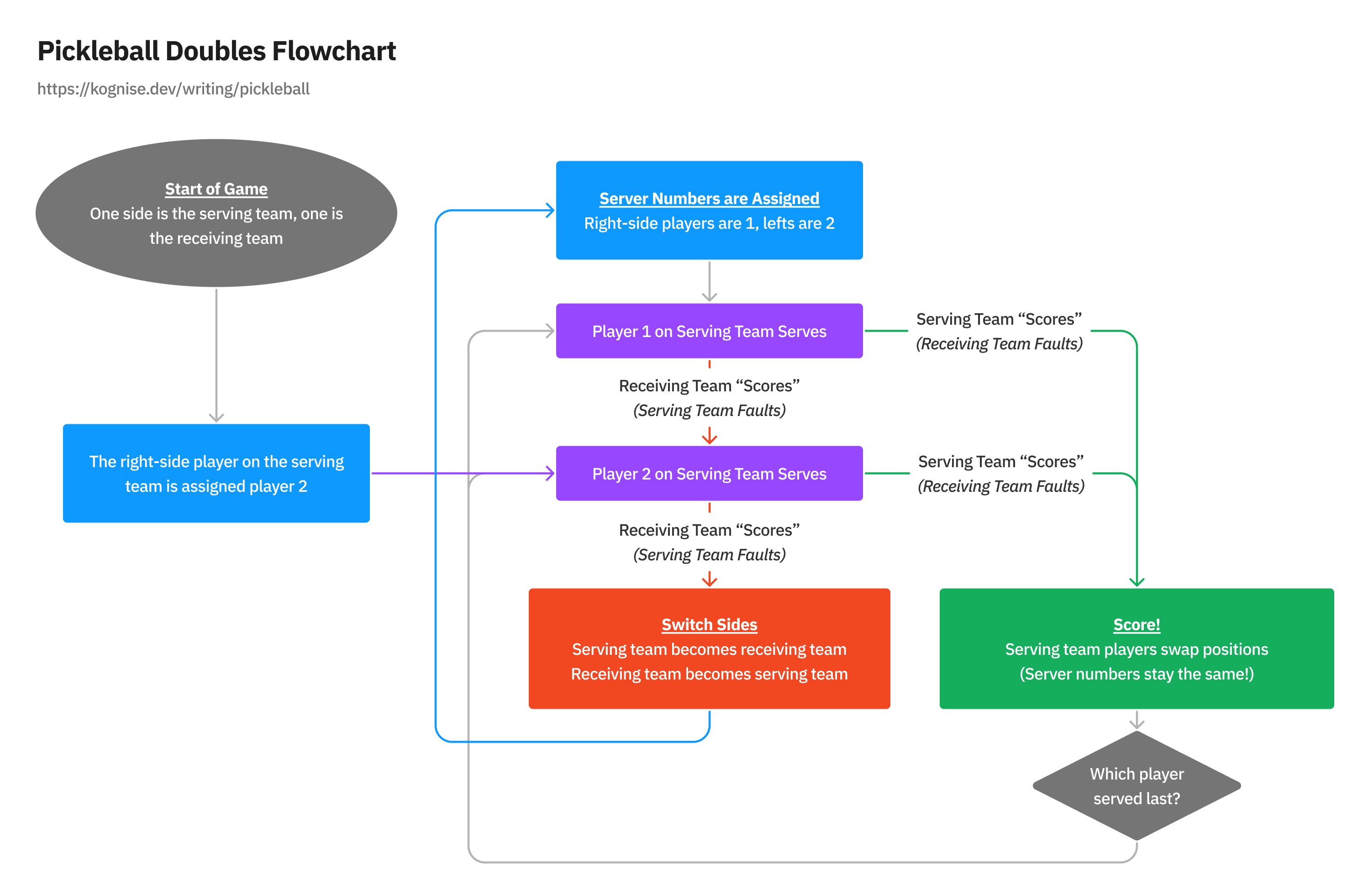
A side out means the serving team loses the serve and it switches to the other team.

Server
The player who is currently serving.
Receiver
The player returning the serve.
First Server / Second Server (Doubles)
In doubles, each team typically gets two servers before a side out.
How to Call the Score in Pickleball (The Correct Way)
Pickleball score is called before every serve, and it’s called by the server.
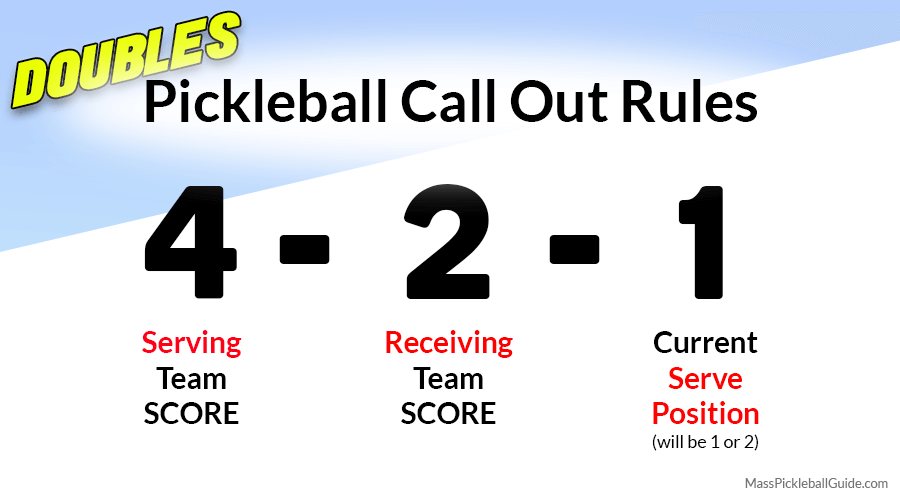
Doubles Score Format
Server’s score – Receiver’s score – Server number
Example:
“7 – 4 – 2”
That means:
-
Serving team has 7
-
Receiving team has 4
-
The server is the second server on the team
Singles Score Format
Server’s score – Receiver’s score
Example:
“6 – 3”
No third number in singles.
Pickleball Doubles Scoring Explained (Step-by-Step)
Doubles scoring is what confuses beginners most, so let’s break it down clearly.
In Doubles, Each Team Gets Two Serves (Usually)
That means:
-
Player A serves
-
If Player A loses the rally → Player B serves
-
If Player B loses the rally → side out
-
Then the other team serves
Example Rally Flow (Easy Version)
Let’s say Team 1 is serving at 0–0–2 (common start format).
-
Team 1 serves → wins rally → score becomes 1–0–2
-
Team 1 serves again → loses rally → serve goes to partner (same team)
-
New server calls 1–0–1 (now first server)
-
If first server loses rally → side out
-
Team 2 now serves
📌 The serving team keeps scoring until they lose a rally.
Why Do We Say “1” or “2” at the End?
That third number tells everyone which server is serving.
-
1 = first server
-
2 = second server
It prevents confusion about who should serve next.
How the First Serve of the Game Works (Special Rule)
At the very start of a doubles game, the first serving team begins with:
👉 Only ONE server (not two)
That’s why many games start at:
“0–0–2”
Meaning: the starting team begins with the second server designation to keep the game fair.
After that first side out, both teams get two servers as normal.
Pickleball Singles Scoring Explained
Singles scoring is simpler because there’s only one player per side.
Singles Rules:
-
Only the server can score
-
Score is called with two numbers
-
Serve always goes to the opposite diagonal box
Where You Serve From in Singles
A simple rule helps:
-
If your score is even (0, 2, 4, 6…) → serve from the right side
-
If your score is odd (1, 3, 5, 7…) → serve from the left side
This makes it easy to know where you should stand.


How to Keep Score in Pickleball (Beginner Tricks)
If you keep forgetting the score, use these easy methods:
✅ Trick 1: Remember the Last Rally Winner
Ask yourself:
“Who won the last rally?”
That’s usually the team that is serving now.
✅ Trick 2: Check Who Is Serving
In doubles, if the wrong person is serving, the score is likely wrong too.
✅ Trick 3: Use a Simple Reset Phrase
When confused, pause and say:
“Let’s confirm: serving team score first.”
This avoids arguments and keeps games friendly.
Common Pickleball Scoring Mistakes Beginners Make
Here are the most common errors that cause confusion:
❌ Mistake 1: Calling the Receiving Team’s Score First
Correct format is always:
Serving team score first
❌ Mistake 2: Forgetting the 3rd Number in Doubles
That third number is important to track first/second server.
❌ Mistake 3: Thinking You Score Every Rally
Remember: only the serving team scores.
❌ Mistake 4: Serving From the Wrong Side in Singles
Even = right, Odd = left.
Visual Guide: Doubles Score Calling Example
If you want to include a helpful visual for beginners, this is a great spot.

Pickleball Score Rules That Matter During Games
Can you score a point if you weren’t serving?
No. If you win a rally while receiving, you only win the serve.
What happens after a side out?
The other team begins serving from the right side, then alternates.
Do you always win by 2?
Yes, standard play requires winning by 2 points.
How Scoring Connects to Strategy (Quick Tip)
Understanding scoring helps strategy because it teaches you:
-
When to play safe (protect a lead)
-
When to take risks (down by 2–3 late game)
-
How to manage pressure as the serving team
A calm, confident scoring mindset reduces mistakes — especially for beginners.
Quick Gear Note (Soft Recommendation)
While scoring is about rules, learning pickleball gets easier when your equipment feels comfortable and predictable.
Many new players prefer paddles that offer:
-
A balanced feel
-
Control for dinks and returns
-
A grip that feels stable during longer games
If you like to combine performance with personality, customized pickleball paddles from PickYoBall are designed to support control-based play while letting you stand out on the court — without feeling overly aggressive or hard to manage.
Conclusion
Pickleball scoring seems confusing at first, but once you learn the key rule — only the serving team scores — everything becomes much easier.
To recap:
-
Doubles uses three numbers: server score – receiver score – server number
-
Singles uses two numbers
-
Games are usually to 11, win by 2
-
“Side out” means the serve switches teams
With this guide, you can now keep score confidently and enjoy the game without the constant “Wait, what’s the score?” moments.
FAQs: Pickleball Scoring Explained
❓ How do you score points in pickleball?
Only the serving team scores points when they win a rally.
❓ Why are there 3 numbers in doubles scoring?
The third number shows whether the server is the first or second server on the team.
❓ What does “side out” mean in pickleball?
Side out means the serving team loses the serve and the other team gets to serve.
❓ What score do you play to in pickleball?
Most games are played to 11 points, win by 2. Some tournaments use 15 or 21.
❓ How do you know which side to serve from in singles?
Even score = serve from right. Odd score = serve from left.


